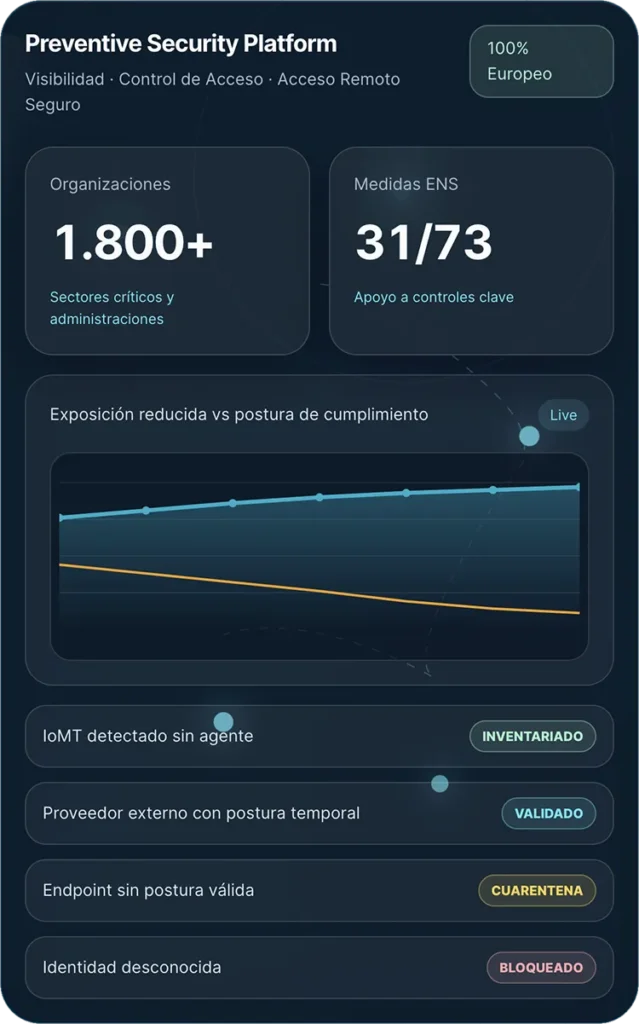
The European platform that restores network control
OpenNAC Enterprise by Cipherbit is a European Network Access Control (NAC) platform designed to provide visibility, access control, and secure remote access from a single policy engine.
Discover all connected assets, assess the context of each access, and automatically apply the necessary security policies to protect IT, OT, IoT, and IoMT environments without replacing existing infrastructure.
Provides traceability, inventory, and access control aligned with ENS, NIS2, and DORA.
Contained Financial Risk
Quarantine, segmentation, and remote access with posture reduce the likelihood of incidents and downtime.
The Current Challenge
The Network No Longer Has a Perimeter
Digital transformation has turned the network into an ecosystem where users, IoT devices, industrial systems, medical equipment, external providers, and remote employees coexist.
Without visibility or dynamic policies, any asset can become an entry point to critical systems.
HOW OPENNAC ENTERPRISE PROTECTS
Risk builds step by step. OpenNAC stops it before an incident occurs.
01
Discover
Automatically discovers all connected assets, including IT, OT, IoT, and IoMT devices.
02
Identify
Associates each device with its identity, criticality, and trust level.
03
Assess
Analyzes identity, security posture, context, and risk level before allowing access.
04
Decide
Automatically applies the defined policy for each user, device, or third party.
ON
Protect: OpenNAC Interrupts the Chain
Allows, segments, limits, isolates, or blocks access based on detected risk.
Capabilities
Three Modules. A Single Policy Engine.
OpenNAC Enterprise combines three complementary capabilities to offer a complete network overview and apply adaptive access controls from a single platform.
Module 1
Visibility
Know everything connected to the network.
Discover and classify IT, OT, IoT, and IoMT assets using active, passive, or agent-based techniques to maintain an updated inventory and a complete view of the environment.
Result: complete inventory, quantified exposure, and real operational governance.
Use: passive visibility for IoMT/OT; passive, active, or agent-based for managed IT.
Clear limit: remediation of legacy vulnerabilities depends on the client’s operational windows and decisions.
Module 2
Access Control
Only allow necessary access.
Applies Zero Trust policies based on identity, posture, and context to dynamically grant, limit, or deny access.
Result: full, segmented, guest, privileged, or denied access based on risk.
Use: AD, LDAP, SSO, certificate, MFA, AV posture, patches, and configuration.
Clear limit: policies must be defined and approved with the security and operations team.
Module 3
Secure Remote Access
Native WireGuard VPN, MFA/2FA, posture validation, full-tunnel, and dissolvable agent for third parties.
Result: secure connectivity from any environment and controlled access to authorized resources.
Use: Windows, macOS, Linux, Android, and iOS; third parties without permanent installation.
Clear limit: the scope of remote access depends on profiles, approved resources, and corporate policy.
Specifications and Interoperability
The technical part, presented as a clear decision sheet.
Architecture
Software-first
Designed to run on existing infrastructure.
OpenNAC Enterprise adopts a software-first approach that leverages existing infrastructure and integrates with the organization's technological ecosystem.
OT maintenance segment · authorized resource within time window.
Detected Activity
Identity validated, temporary incomplete posture, and access request outside profile.
Risk
Non-compliant external access; possible exposure of critical segment.
Mitigation Applied
Limited access, isolated VLAN, audited session, and alert sent to SIEM/SOC.
Recommended Action
Review authorization, validate device posture, and approve exception if applicable.
Governance and Compliance
Technical controls aligned with European regulatory frameworks.
OpenNAC Enterprise converts regulatory requirements into operational controls through continuous inventory, access control, segmentation, and traceability over users, devices, and third parties.
ENS
Inventory, access control, and evidence
NIS2
Risk, third-party, and continuity management
DORA
Operational resilience and access supervision
CPSTIC 105
Trust for critical organizations and environments
Trust Center
Verifiable Trust for Procurement, Security, and Compliance.
CCN-CERT / CPSTIC 105
STIC 105 Catalog since 2018
Gartner Market Guide for NAC
Included 4 consecutive times
ENS / NIS2 / DORA
Operational alignment
1,800+ organizations
Proven adoption
Evidence and data
Available upon request
Recommended information for procurement and privacy teams
Residency and retention
Document in proposal or contract based on client environment.
Sub-processors
Relationship and changes available under provider process.
Incident notification
Commitments to be formalized in SLA, DPA, or service agreement.
Audit and DPIA
Evidence, certifications, and support for risk assessments.
Business Value
More Visibility. More Control. Less Exposure.
OpenNAC Enterprise transforms network security into an operational capability that allows knowing what is happening at all times, applying dynamic access policies, and maintaining control over users, devices, and third parties from a single platform.
European platform1.800+
organizations protected with visibility, access control, and secure remote access.
01Reduce exposure
Continuous inventory and policies that transform unknown devices into manageable risk.
02Protect continuity
Control without disruption for hospitals, OT, essential services, and distributed networks.
03Simplify operations
A single policy engine for IT, IoT, OT, IoMT, third parties, and remote access.
04Demonstrate compliance
Evidence, traceability, and governance aligned with ENS, NIS2, DORA, and CPSTIC.
Success Story
Hospital Clínic Barcelona: visibility and control without operational interruption.
In a highly complex clinical environment, with IoMT devices, OT systems, and thousands of connected devices, OpenNAC enabled progress towards a Zero Trust architecture with guided migration.
managed devices
0+
centers migrated
0
visibility
0%
Zero Trust
applied architecture
Key Results
Greater autonomy for the hospital’s technical team.
Migration across more than 24 centers without operational interruption.
Dynamic segmentation by device type, service, and risk level.
Increased agility in queries and decision-making thanks to integrated CMDB and analytics.
“OpenNAC allowed us to have complete visibility of everything connected to our network, something we had never had before.”
Paco Sánchez, Head of ICT Security – Hospital Clínic Barcelona
Why Cipherbit?
A European manufacturer with an operational, not just technological, vision.
While other providers sell isolated components, Cipherbit builds a preventive security platform designed for critical, regulated, and distributed organizations.
1800+ organizations protected
European sovereign technology
01
Software-first
No dependence on proprietary hardware.
02
Infrastructure agnostic
Integrates with the existing ecosystem.
03
Sectoral specialization
Experience in healthcare, industry, public administrations, and defense.
04
Adaptability
The platform adapts to proprietary hardware.
05
Continuous innovation
Zero Trust, secure access, and new capabilities.
06
Expert support
Technical assistance throughout the solution’s lifecycle.
Implementation
A progressive, secure, and uninterrupted deployment
The implementation model combines initial assessment, lab testing, pilot, gradual migration, and technical support to minimize risks and accelerate adoption.
Licensing and Implementation
Modular and adapted to each organization
OpenNAC Enterprise allows incorporating only the necessary capabilities—Visibility, Access Control, and Secure Remote Access—facilitating progressive implementation aligned with the needs of each environment.
Regain control of your network.
Discover how OpenNAC Enterprise can help you understand everything connected to your infrastructure, apply adaptive access policies, and evolve towards a Zero Trust model prepared for the most critical environments.